Turning operational complexity into competitive advantage
The Situation:
A company was growing rapidly and felt the pain in scaling their operations. Striving for Operational Excellence where success was measured by a fully automated Quote to Cash (QTC) process.
The approach:
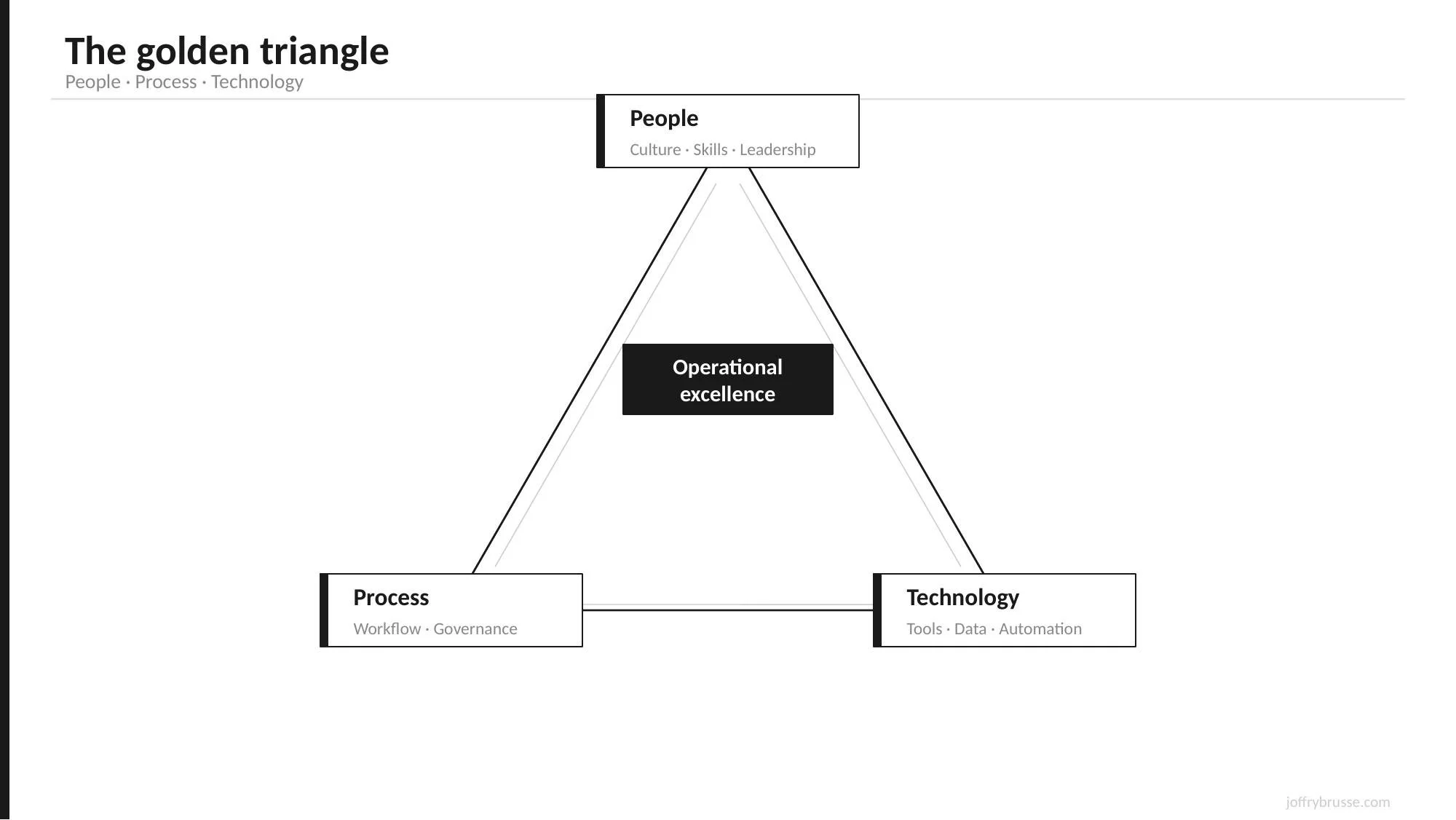
By applying the Golden Triangle Framework, work streams were categorised in 3 strategic pillars with the following deliverables:
People
Create ownership and accountability
Build a strong Operations team
Introduce new ways of working / create synergies
Communications and Collaboration
Process
Process register
Turtle diagrams
Value stream mapping
Standard Operating Procedures (SOP)
Data and Metrics
Governance
Systems
Simplified tech stack
Upgraded tech stack
Controlled automation
Data migrations and sync
introduction across technology of UUID (Universally Unique Identifier)
The Program:
After the workshops, interviews, mapping exercises, meetings and alignment sessions the program was defined and resulted in numerous projects. Some run in parallel where others where dependent on projects to be finalised before the next could kick-off.
Full Rebuild of System integrations and Automations (Workato)
Provisioning
CRM Consolidation + Migration (3 existing CRM systems into a single new CRM: Hubspot)
PSP Consolidation + Migration (2 existing Billing systems into a single new system; Stripe)
Introduction Product catalogue
Sales Pipeline Consolidation (Single global Sales pipeline)
Data Maturity project
Data Cleansing project
The architecture had some challenges due to the structure and number if direct integrations between technologies.
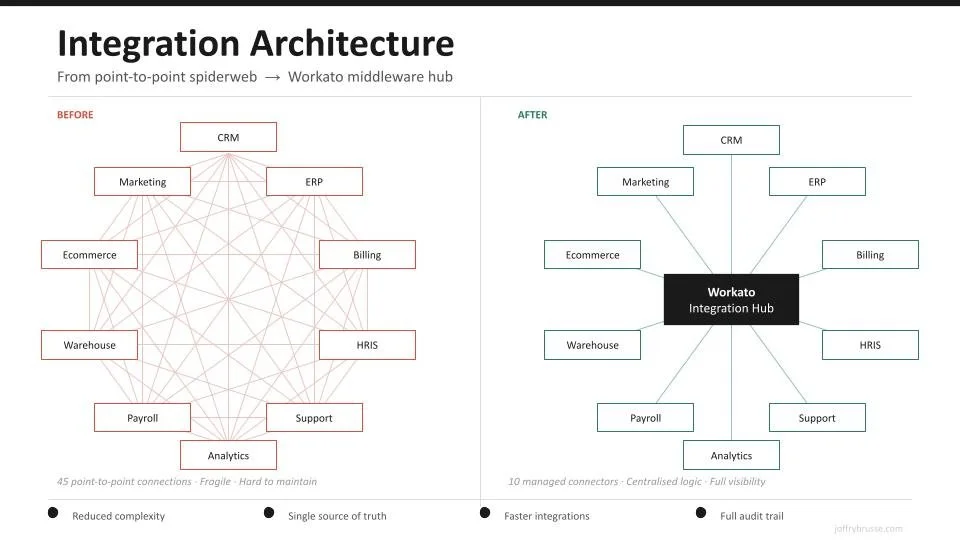
Single point of control — every integration lives in one place. When something breaks or needs changing, you know exactly where to go instead of hunting through bespoke code across multiple systems.
Drastically reduced complexity — 10 managed connectors replace up to 45 point-to-point connections. Each new system you add requires one connection to Workato, not connections to every other system already in your stack.
Faster time to integrate — Workato's pre-built connectors and recipe library mean new integrations take days, not weeks.
Centralised error handling and alerting — when an integration fails, Workato catches it in one place and notifies you.
Full audit trail and observability — every data flow, trigger, and transaction is logged centrally. You can see exactly what moved between which systems, when, and why
Non-technical teams can build and maintain workflows — Workato's no-code/low-code interface means operations and business teams can own integrations without depending on developers for every change.
Easier to onboard or replace systems — swapping out a CRM or adding a new tool means updating one Workato connector, not re-engineering every system it previously spoke to directly.
Built-in security and governance — credentials, API keys, and data access are managed centrally with role-based permissions.
Scalability without exponential cost — adding the 11th system to a spiderweb means up to 10 new connections. In a Workato model, it's one. The more systems you run, the more dramatic this advantage becomes.
Consistency across data flows — business logic (field mappings, transformations, validation rules) lives in one place. In a spiderweb, the same logic gets duplicated and gradually drifts out of sync across different integrations, leading to data inconsistencies that are notoriously hard to trace.
Benefits of this particular approach;
The Results:
"The result was a leaner, faster, more resilient operation — built to grow."
People
Defined ownership and accountability across the full Quote to Cash process
A structured Operations team with clear ways of working, reducing reliance on tribal knowledge
Stronger cross-functional alignment between Sales, Finance, and Operations
Process
End-to-end QTC process fully documented, standardised, and governed
A single source of truth for data and metrics, enabling faster and more confident decision-making
Governance model in place — decisions have a clear owner and a clear path
Technology
Consolidated from 3 CRMs and 2 billing systems into single best-in-class platforms
Eliminated data inconsistencies caused by fragmented, poorly integrated systems
Automations that scale with business growth without requiring additional headcount
Reduced manual effort across the operation — less time fixing, more time building
Overall
The business can onboard new customers faster, with less friction between sale and invoice
Operations moved from bottleneck to growth enabler
A resilient, scalable foundation that supports the business at its next stage of growth
For confidentiality reasons, specific metrics such as error rates, revenue impact, and cost savings have been omitted. This engagement relates to a publicly listed company.